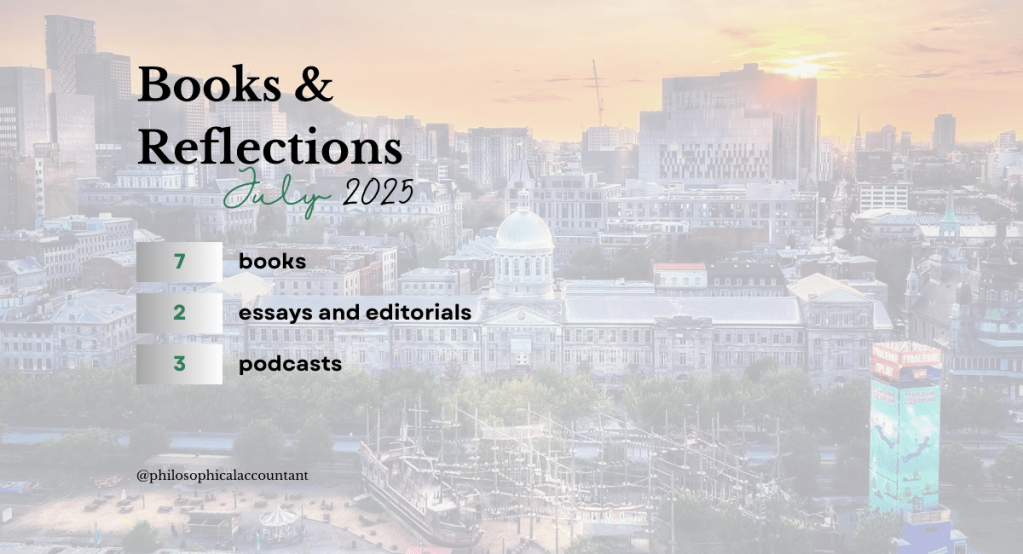
Welcome to Books & Reflections, my regular roundup of what I’ve been reading, watching, and reflecting on how it shapes my work, my writing, and myself.
Picture by me, 2025: view of Montreal skyline at sunset from la Grande Roue de Montreal.
📚 Inputs & Influences
Books – Fiction
The Mysterious Affair at Styles. Agatha Christie, 1920.
Poirot Investigates. Agatha Christie, 1925.
The Murder of Roger Ackroyd. Agatha Christie, 1926.
Partners in Crime. Agatha Christie, 1929.
Books – Non-fiction
Funded: The Entrepreneur’s Guide to Raising Your First Round. Katherine Hague, 2017.
The Hard Thing About Hard Things: Building a Business When There are No Easy Answers. Ben Horowitz, 2014.
I Never Thought of It That Way: How to Have Fearlessly Curious Conversations in Dangerously Divided Times. Mónica Guzmán, 2022.
Essays & Editorials
I’m a Couples Therapist. Something New Is Happening in Relationships. Dr. Orna Guralnik, The New York Times, 2023.
As a Couples Therapist, I See the Same Destructive Patterns in Our Political Discourse. Dr. Orna Guralnik, The New York Times, 2024.
Podcasts
Orna Guralnik (Couples Therapy). Armchair Expert with Dax Shepard.
If It’s Hysterical, It’s Historical | Orna Guralnik. 10% Happier.
Jon Stewart & Team Talk Evolving the Show, Covering the Election, Processing Trump 2.0 – FYC. The Daily Show.
🔍 What’s Sticking With Me
In her 2024 op-ed for the New York Times, psychoanalyst Orna Guralnik explores splitting – a defense mechanism where we divide people into all-good or all-bad to avoid confronting uncomfortable emotions like shame and uncertainty. While natural in childhood, Guralnik warns that this binary way of thinking now plays out at a societal level, fueling polarization. “Splitting produces a kind of ecstatic righteousness,” she writes, “an intoxicating thrill in hate… free from complexity and uncertainty.” Social media, with algorithms designed to maximum time on their platforms, intensifies this dynamic by trapping us in echo chambers. The path forward, Guralnik suggests, lies in moving to a more integrated, mature mindset, “within which one can reconcile ambivalence, manage feelings of loss, take responsibility and repair harm in relationships.”
If Guralnik diagnoses the psychological roots of polarization, The Daily Show team shows how it plays out in media. Technology enables rapid editing and instant reach, but also fragments context – clips circulate stripped of their narrative, making satire harder to recognize and easier to misconstrue. Against the internet and social media’s push for quantity and virality, they double down on quality and craft, trusting that audiences still crave connection over noise. Field reporting, which brings correspondents face-to-face with Americans across the country, grounds the comedy in lived experience and a reminder that respect and decency often surface most clearly offline.
Mónica Guzmán, in I Never Thought of It That Way, offers a practical path forward: bridging divides through curiosity instead of judgment. She explains how polarization grows through Sorting, Othering ,and Siloing, and how asking open questions like “What am I missing?” can interrupt that cycle. Drawing from her life as the liberal daughter of Mexican immigrants who twice voted for Trump, Guzmán shows that empathy doesn’t require agreement, but it does demand humility and the courage to let go of certainty. Through stories, strategies like her “CARE” approach to questions (Curious, Answerable, Raw, Exploring), and cross-partisan initiatives like Braver Angels, Guzmán demonstrates that connection is possible when we prioritize understanding over persuasion. As she reminds us, “Curiosity is stronger than fear. It’s what bridges the gap between us and the people we think we cannot understand.“
These perspectives highlight the same truth: individually and collectively, our challenge is to resist the seduction of simplicity and reclaim the essential work of messy nuance.
💬 One Sentence I Can’t Shake
Interest in difference is a place of potential growth and repair.
Guralnik, Orna. ‘As a Couples Therapist, I see the Same Destructive Patterns in Our Political Discourse’. The New York Times, 2024.
🧠 The Big Question
Over the years, therapy has helped me notice a pattern: whenever I felt self-righteous anger about someone’s behaviour towards me, chances were I was splitting. It was easier to pin my problems on a single villain than to face the complexity of relationships. What helped me shift was: both things can be true and just like me. Yes, marketing may be stubborn about privileging story over facts, and also they care about the deadline as much as I do. Yes, that woman was rude when she spilled her coffee on me, but she seems stressed about being late – just like me. These phrases nudged me from rigid blame towards curiosity.
In early 2025, in the lead-up to Canada’s federal election, I once again felt the pull of splitting. Media coverage painted the country as fractured. Social platforms were filled with harsh commentary about our leaders and their supporters. My first instinct was withdrawal: delete accounts, shrink my circle, spend long hours at the boxing gym. Life echoed Guralnik’s words: “To protect this brittle and distorted version of reality, we resort to extreme defensiveness. We frame opposing arguments as a threat to our identity and values.”
So I volunteered in my local riding – my first time canvassing. I was nervous, but the door-to-door conversations surprised me. I met people who shared my values but disagreed on which party could best uphold them. Others were disengaged altogether, focused on daily struggles. It was draining at first – I was tense and guarded – but little by little, I relaxed and started to “see these viewpoints as part of a complex social fabric rather than existential threats to our values and ourselves.“
Looking back, I see that I was practicing Guzmán’s INTOIT framework. Instead of staying in my bubble of outrage, I put myself face-to-face with people whose perspectives challenged me. I wasn’t there to persuade or argue, but to listen to what mattered to them, to ask how did you come to that view? and to sit with answers that didn’t fit neatly into my categories. In other words, I was training myself to stay curious in the thick of difference – and I experienced a few “I never thought of it that way” moments along the way.
Volunteering became my defense against splitting: if the election outcome disappointed me, I could at least know I had acted in alignment with my beliefs. A deeper insight has stayed with me: outrage is a signal that I am not taking enough constructive action. When I channel that energy into doing something – even something small – the edge of self-righteousness fades. With that inner grounding, curiosity returns and I can be a bridge-builder instead of another contributor to polarization.
💡 What I’m Curious About Next
We are living through upheaval on many fronts: political, economic, cultural, environmental, technological, humanitarian. No wonder splitting is tempting: every day brings a fresh moral dilemma. There are days when I just want to hit pause and reset. My favourite practice? Escaping into fiction written during the interwar and post-WWII years.
It makes sense, I suppose, that in today’s fractured climate I reach for stories from another polarized era. After WWI – the deadliest conflict in history at the time – Europe reeled from redrawn borders, collapsed empires, and social clashes. Economic optimism of the Roaring Twenties gave way to the Great Depression, while totalitarian regimes in Germany, Italy and Spain were on the rise. If social media had existed back then, there would have countless been memes about unprecedented times.
And yet, much of the fiction of that period doesn’t dwell on catastrophe. Instead, the Golden Age of Detective Fiction assured readers that bad deeds never go unpunished and resolution always restores order. Georgette Heyer reimagined the Regency novel, where frivolity masks intelligence, and humour prevails. These books suggest a collective craving for order, joy, and moving forward.
Which makes me wonder: maybe escapism is not a weakness but a survival tool – a way of metabolizing division and fear. Escapism gives us not just relief from the weight of the moment, but also the resilience to re-engage with it. That’s why I’m curious to keep exploring how stories – past and present – point us toward the possibility of living together again.
📝 Creative Update
For anyone living in the Montreal area and looking for a joyful moment, I highly recommend Polyphonie Mtl. They’re a pop-up choir that meets once a month to sing 3-part arrangements of popular songs. There’s something magical about spending three hours with a room full of strangers, creating harmony in our disharmonious world. So far I’ve attended 2 of their events: once we sang a medley of Lion King songs… in French, and in July we sang a Coldplay medley – days before the jumbotron incident!
Next edition is Septembre 14th. I can’t wait.
📣 Closing Thoughts
Does the concept of splitting resonate with you? How do you manage the pull of polarization in your own life?


Leave a reply to Books & Reflections – August 2025 Edition Cancel reply