Intro
I turned 40 this summer, and predictably, I’ve been working through a mid-life crisis. It’s been building for the past two years: I spent a lot of money on a fantastic education at a the top business schools, only to realize my big dream is to be an author(*). What to do? Well, I decided to do what all the professors preached: be bold. I’ve put my career on ice to give writing a real shot. Notw sitting in my self-imposed struggling artist reality, my doubts and fears weigh heavily. I struggle to find my voice.
My two loudest insecurities are:
- My stories are not that special. My traumas, though painful, are the scars that come with being alive. I’m acutely aware of my privilege: white, middle-class, Canadian. Who am I to add to the noisy world we live in?
- I am not a salesperson, of ideas, frameworks, information, etc. Memoirists like Glennon Doyle share personal stories to inspire change or shift mindsets. But I see my stories as mirrors – reflecting back whatever the reader sees in themselves. That is enough for me, but will it ever be enough for the publishing industry?
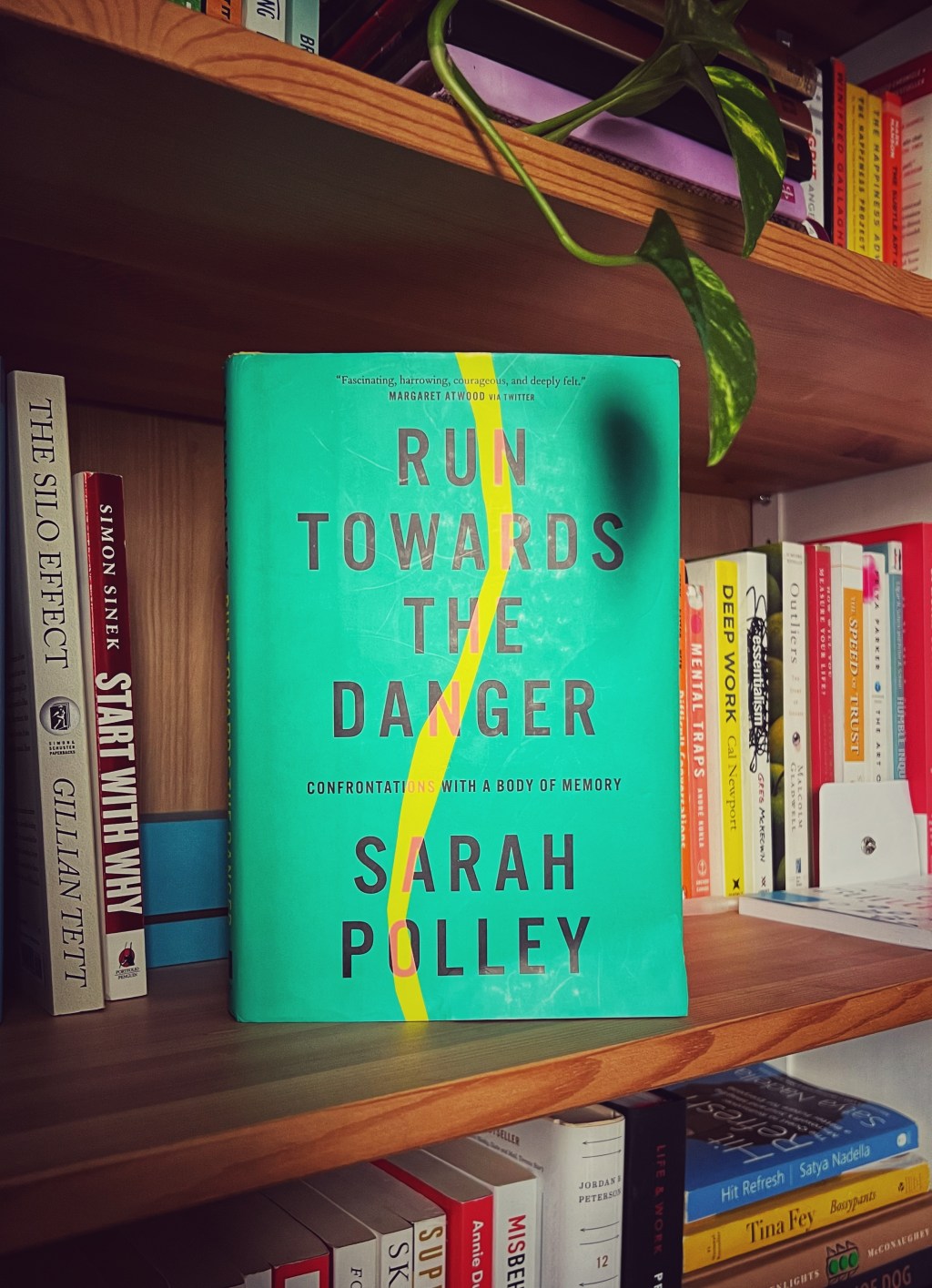
Sarah Polley’s Run Towards the Dangers: Confrontations with a Body of Memory challenged me on both of those counts. Her memoir explores six deeply personal essays – relatable stories despite her unique life as a child actor turned Academy Award-nominated filmmaker. Polley isn’t the most famous or successful; she is simply herself. She writes to unlock something within, and in reading her, we unlock something in ourselves. That is enough.
What follows are some of the most dangerous stories of my life: the ones I have avoided, the ones I haven’t told, the ones that have kept me awake on countless nights. These are stories that have haunted and directed me, unwittingly, down circuitous paths. As these stories found echoes in my adult life, and then went another, better way than they did in childhood, they became lighter and easier to carry.
This book came to me at a time when I craved a model of excellence for what I am seeking to do. Polley’s essays remind me of the power that comes from exploring the messy of our lives, and of sharing that messy with others. Reading them, I feel less alone, my fears less overwhelming, my doubts less shameful. I am curious to discover who I will become if I run towards the danger of storytelling. What a gift.
6 Essays
In Alice, Collapsing, Polley describes her experience acting in the lead role of the play adaptation of Alice in Wonderland, at 16 years old, in Stratford, Ontario. This was Polley’s first and only experience on stage, having spent her childhood working on films and TV shows. Polley weaves together several storylines:
- The dangers of growing up without proper boundaries. Polley moved out at 16, five years after her mother’s death and her father’s emotional withdrawal. The lack of boundaries in Polley’s life made the chaos of the Wonderland world much more threatening, leading to a gradual inability to separate her life from the fairytale world.
- The bewildering terror of stage fright: towards the end of the play’s run, Polley requested invasive surgery to fix her aggressive scoliosis rather than face taking the stage one more time.
- Reconciling the beloved Alice in Wonderland tales with the unsettling claims that Lewis Carroll (pen name of Charles Dodgson) was a repressed pedophile with an unhealthy interest in Alice Liddell, the 11 year-old girl on whom the novel is based.
- Exploring her father’s obsession with Alice in Wonderland, and his deep empathy for Charles Dodgson.
At 60 pages, this essay is the book’s longest and a testament to Polley’s skill as a writer. She seamlessly threads flashbacks and flash-forwards, building to a satisfying conclusion of acceptance and forgiveness.
Recently, when I described this moment in the play to my therapist and the scenes of Dodgson’s rejection by Alice in ‘Dreamchild’, I tried hard to talk about my anger at being made to feel sad for the grown man instead of for the child, but all that came out of me was the sadness itself, a sadness so fierce I couldn’t speak for my sobbing. My therapist said, quietly, “There is something tremendously sad about being a pedophile. To love a creature you can’t have. To know that that love is bad. To know that you are bad for having these feelings, even if you don’t act on them. It’s tremendously sad.”
In The Woman Who Stayed Silent, Polley unpacks her decision to not come forward during the Jian Ghomeshi trial.
Jian Ghomeshi, a celebrated CBC Radio Host and cultural figure in Canada, was accused in 2014 of multiple counts of sexual assault. The accusations ended his career and led to a highly publicized 18-month criminal trial. By the trial’s end, Ghomeshi was acquitted on all counts because the complainants’ testimonies had “inconsistencies”, which his defence team skillfully used to tear apart their credibility. Their strategy didn’t just clear Ghomeshi – it destroyed the women who came forward. Their characters, their reputations, and for some, their mental health. At least one complainant later admitted the trial experience had left her suicidal.
Polley shares her shifting memories of the assault she experienced at 16 years old and explores how she lived the common phenomenon amongst victims to continue interacting with their attackers to regain control or reshape the narrative of what happened to them. This phenomenon, now understood by psychologists, wasn’t as widely recognized during the trial. Polley also explores the gap between victim’s realities and the justice system’s standards of proof.
Most of the lawyers I have spoken with insist that nothing should change in the way that sexual assault cases are tried, that defence lawyers generally behave very well in courtrooms and in accordance with Canada’s very progressive rape shield laws (…), but they would, once again, never advise a woman they loved to come forward in a sexual assault case. How they manage to hold both these beliefs simultaneously and confidently is endlessly fascinating to me.
In High Risk, Polley recounts her first pregnancy, complicated by gestational diabetes and placenta previa. While confined to a high-risk ward, she revisits her relationship with her mother, who died when she was 11, and explores how motherhood is reshaping her grief.
I say I that I didn’t know how much I missed my mother until I was pregnant. I say that I didn’t know how angry I was at her for dying. I say that now that I’ve lived two and a half years with my child, and felt the intensity of our subterranean, inexpressible and indelible knowledge of each other, I’ve gone from feeling that eleven years with my mother was not very much, not nearly enough, to knowing that to feel adored and cherished by a mother who was full of warmth and joy is quite a lot, actually.
In Mad Genius, Polley revisits the dangerous experience of filming The Adventures of Baron Munchausen at age 9, under the directorship of Terry Gilliam, of Monty Python fame. Though the whimsical adventure tale is beloved by audiences (I grew up watching that movie!), its production was unsafe and chaotic. Polley played the Baron’s faithful sidekick and experienced several scary incidents, including a concussion from explosions going off close to her head. She struggles to accept that the the adults charged with protecting and caring for her forfeited their responsibilities, so she doubts her memories as a result. The essay ends with Polley watching the movie with her 9 year-old daughter and discovering that both things can be true: it was a traumatic experience for her, and it is a magical movie for audiences.
‘She was right. She was in danger. Many times.’ I read these nine words over and over again. Someone who was there was appearing from out of nowhere to confirm my memories and verify my version of events.
In Dissolving Boundaries, Polley and her family visit Prince Edward Island on a whim, after Polley has a dream that she played on the PEI beaches with her eldest daughter. PEI holds complicated memories for Polley as that is where Road to Avonlea, the show that brought Polley widespread recognition in Canada, was set. Polley describes the experience of child acting as “gutting” and suggests that fame is not an appropriate burden to place on a child, ever: a child is not equipped to handle the bewildering possessiveness that fans feel towards their favorite celebrities. Adolescence is confusing for everyone, but spending it on a TV show, learning that one’s worth is tied to one’s ability to not be authentically oneself, is a difficult foundation for navigating adulthood. This story ends with Polley realizing that times have changed, no one recognizes her in PEI anymore. She spends a wonderful trip on the island, building beautiful new memories with her daughters.
I had never asked for such help in mourning my mother. And as it turned out, it was far from helpful. Because some of the first tears I had shed about my mother’s death after the day she died were in aid of a performance, I was unable to produce genuine tears of grief for years to come. Crying about my mother felt false, poisoned with the feeling that these tears had been used to further the agenda of a TV show rather than to genuinely express the loss of her. It was decades before I was able to cry about my mother’s death without feeling disingenuous about it.
In Run Towards the Danger, Polley shares her long road to recovery following a severe concussion. Stripped of her ability to move through life normally, Polley explores the breakdown in identity that comes with distrusting one’s body and one’s mind, and the helplessness that sets in as the distrust becomes permanent. Eventually, she discovers a clinic in Pittsburg that has an unorthodox treatment protocol for concussions and finds her way back to herself. Her lesson? Growth comes from running towards the danger; healing does not happen by listening to one’s body at the expense of one’s vitality.
About two weeks later, David sits at the end of our bed as I drift off to sleep and begins to sob uncontrollably. It’s only then that it occurs to me that it is possible that something very, very bad has happened.
Reaction
How I loved this book! For both the content and the form.
Alice, Collapsed resonated strongly with my own struggles to control my mind. The Woman Who Stayed Silent gave me words my profound disillusionment during the Ghomeshi trial: there is no justice, only silence. High Risk made me wonder for the first time in my life what I’ve missed by not having kids; is my relationship with my mother forever stunted bc I have cut myself off from an experience that would have allowed me to understand her better? Mad Genius was a comfort to me, because I too have struggled to make sense of people’s behaviour that violates my core values, and tend to assume that my confusion must be a result of my unreliable memories. I doubt myself so as to not doubt others. Dissolving Boundaries made me question the cost of the para-social relationships we all have with celebrities, especially child celebrities. I am less passive and entitled as a consumer of entertainment. And Run Towards the Danger was a wake up call to stop hiding behind self-care and face what’s uncomfortable.
Why do we write things about ourselves? To absolve ourselves of guilt? To confess? To right a wrong? To be heard? To apologize? To clarify things for ourselves or others? I’ve wondered all these things as I sit down to write this.
Polley’s essays remind us that storytelling doesn’t have to sell an idea or solve a problem. It’s an act of empathy. By sharing her life, Polley gives us the gift of seeing our own differently. I am no child actor, I have not been sexual assaulted by a celebrity, I am not a mother, I never worked with a Python who was irresponsible, I have never been to PEI and most of my injuries and illnesses have been easily recovered from. Yet I move through the world differently now, because for a few hundred pages, I lived another life and saw the world through different eyes. That’s magic!
These stories don’t add up to a portrait of a life, or even a snapshot of one. They are about the transformative power of an ever-evolving relationship to memory. Telling them is a form of running towards the danger.
I also really enjoyed Polley’s form. Her essays are long (20-60 pages) but her style is interesting. She writes in short paragraphs (50-350 words), but each paragraph is its own standalone story: it can be quoted without any context, and still be understood, with a simple beginning, middle and end. The juxtaposition of the simplicity of her micro and flash fiction prose and the complexity and multiple layers in each of her essays makes for a very satisfying and unusual reading experience.
Outro
Would that I one day write something that stirs a reader as much as Polley’s essays have moved me. The only way to hit that objective is to do the dangerous work of telling my stories.
I’ve been writing and unwriting this essay for years now. It’s difficult, when you’ve resisted telling a story for so long, to know where to start. Especially when it has haunted you to not tell it. When it has knocked around inside your brain, loudly in the middle of the night, asking why it didn’t deserve to be told, asking who you might have hurt by not telling it, who you might truly be, deep down, because of your decision not to.
*This video captures the exact moment I realized that my calling is storytelling.


Leave a comment