
I experienced severe mental health struggles from 2015-2022. In 2019, in a desperate attempt to distract myself from the negative thoughts constantly drowning my brain, I took up reading in earnest, a habit which I’ve kept to this day. Much of what I read was non-fiction, as learning of the universal struggle to make sense of the world made the struggle to make sense of my own self less lonely. Quickly I stumbled upon Frankl’s famous quote.
Between stimulus and response there is a space. In that space is our power to choose our response. In our response lies our growth and our freedom.
Top of mind, that quote is cited in:
- Anything written by Brené Brown
- Anything written by Esther Perel
- Maybe You Should Talk to Someone, Lori Gottlieb, 2019.
- The Choice: Embrace the Possible, Edith Eger, 2017.
- Emotional Agility: Get Unstuck, Embrace Change, and Thrive in Work and Life, Susan David, 2016.
- Mindset: The New Psychology of Success, Carol S. Dweck, 2006.
- Multipliers: How the Best Leaders Make Everyone Smarter, Liz Wiseman, 2010.
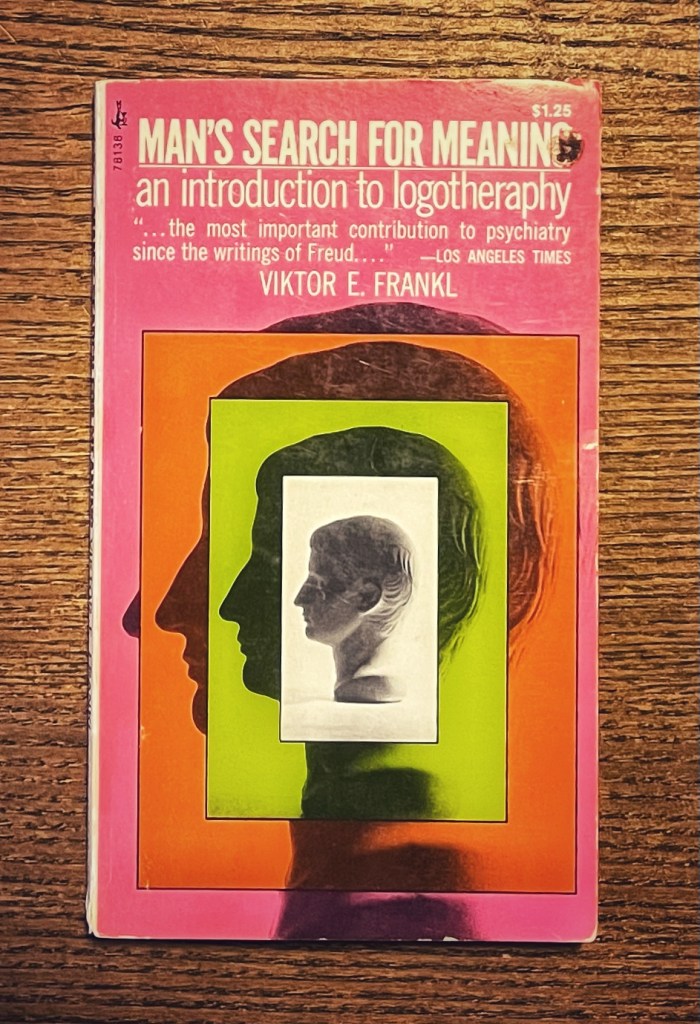
This quote underpins much of current day management theory about empathy and leadership. It has shaped psychology both academically (Dr. Frankl formed a new school of thought, logotherapy, which set the stage for several current day common practices like Positive Psychology and Existential Psychotherapy) and popularly (hence that quote being in every management/psychology/self-help book published in the last decade). Imagine my surprise upon reading Man’s Search for Meaning that the quote is not in fact part of the book?
From Death Camp to Existentialism
Everything can be taken from a man but one thing: the last of human freedoms – to choose one’s attitude in any given set of circumstances, to choose one’s own way.
Man’s Search for Meaning covers Dr. Frankl’s time in concentration camps during WWII, where his both his parents, his wife, and his brother were killed. Dr. Frankl’s sister was his only surviving family member from the war.
The book is unique in its approach in that it avoids chronological series of events and instead focuses on “three phases of the inmate’s mental reactions to camp life (…): the period following his admission; the period when he is well entrenched in camp routine; and the period following his release and liberation.” Through these anecdotes, Dr. Frankl’s memoir serves as an essay for the principles that underpin logotherapy, namely that “the striving to find a meaning in one’s life is the primary motivational force in a man.”
Through my various struggles with mental health issues, I’ve repeatedly felt myself to be groundless, without purpose or any dreams/goals to ground me. Not seeking to equate any of my struggles to the experience of living through concentration camps, it remains that much of Dr. Frankl’s work resonates with me.
What I’ve Learned
Ultimately, man should not ask what the meaning of his life is, but rather must recognize that it is he who is asked. In a word, each man is questioned by life; and he can only answer to life by answering for his own life; to life he can only respond by being responsible.
For the longest time, I viewed responsibility as a trap – something that ties one down. But it is interesting that without responsibilities – to oneself, one’s family, friends, community, work – life gets very hollow and fragile. This has been an interesting reframing, something I only began leaning into in the last few years, beginning with the pandemic. Isolated and alone, like many others, I took stock of my life, and the more I SMSO’d (sorted my shit out), the less fearful and scared I became. To accept responsibility is to accept meaning, and the more I took responsibility for my life, the more I felt grounded in my identity.
It did not really matter what we expected from life, but rather what life expected from us. We needed to stop asking about the meaning of life, and instead to think of ourselves as those who were being questioned by life – daily and hourly. Our answer must consist, not in talk & meditation, but in right action and in right conduct. Life ultimately means taking the responsibility to find the right answer to its problems and to fulfill the tasks which it constantly sets for each individual.
I’ve struggled to define any purpose (meaning) for myself – Dr. Frankl suggests that is the wrong question to be asking. It is not about defining a purpose I deem to be the correct one for myself, but rather getting comfortable with quietening my brain long enough to identify “the right answer to its problems and fulfill the tasks which it constantly sets for” me. The pandemic, once again, expedited this lesson by forcing an external quietening which made it impossible to run from the necessity of an internal quietening. That internal quietening revealed many truths to me that I’ve since been working to execute in “right action and right conduct”: a career pivot, resuming writing, and taking a breather from the dating world until I had sorted through my baggage and my priorities. I realized I’m more of homebody that I’d previously acknowledged, and that hosting friends and family regularly brings me joy. By accepting the responsibility of knowing and accepting who I am and aligning my lifestyle with my identity, I’ve found meaning.
Dr. Frankl encourages us to find meaning in our suffering. As someone with borderline personality disorder traits, I’ve long struggled with a very unstable sense of self, dissociation, and splitting. This has caused much suffering to myself and, through my inability to manage my resulting emotional swings, scar tissue for others. I carry the weight of that with me, forever. However, what the pandemic taught me is that I can face the truth of who I am, and to my surprise, I like who I am. The suffering from my fragmented identity has given meaning to my ongoing journey of building an integrated one. The suffering from having inflicted much emotional strain to coworkers and direct reports at work gives meaning to my commitment to become a good people leader. The suffering from my previously volatile personal relationships gives meaning to each stable relationship I now build and maintain.
Start with Why
A man who becomes conscious of the responsibility he bears toward a human being who affectionately waits for him, or to an unfinished work, will never be able to throw away his life. He knows the “why” for his existence, and will be able to bear almost any “how”.
Who has not heard Simon Sinek’s famous speech, or read his book Start with Why? And yet, before Simon Sinek, there was Viktor E. Frankl. While both recognize the importance of the question Why? Viktor E. Frankl invites us to be comfortable in the struggle to answer that question.
And you? Do you know the “why” for your existence?


Leave a reply to Books & Reflections – July 2025 Edition Cancel reply