
The inscription in this book reads,
1997 –
To June, lover of resplendent wardrobes.
From Ma & Pa, admirers of her style.
I can’t explain why I never read this book until launching this blog. I’ve always had strong opinions on the look and feel of books; this book has a flimsy cover, the font size is large and the paper is quite think. Adolescent June must have deemed this book to be cheaply made, and then falsely assumed that a cheap book would have a bland story. It remained on my bookshelf, forgotten.
When I moved out at 19 years old, my mother was taken aback that I wasn’t taking my book collection with me. She implored me to understand that she’d given me good books, some of which would be hard to find when I was older, so not to disregard the value of them. I heard her but I didn’t, and after all, I was moving into a shared apartment with 2 roommates. I just didn’t have the space or the interest in books, many of which seemed childish. This book remained on my mother’s bookshelves, forgotten.
10 years after my mother’s death, as I began sorting through my mother’s book collection, I started with my books that she’d kept for all those years. I noticed she’d pruned down the collection – without asking me! Noticing I’d never read them nor asked about them, my mother would have deemed it appropriate to find new homes for those neglected books. Funny how time changes perspective: young, I sometimes found my mother’s book gifts for me naggy or preachy. My mother never gave a book gift without reading it first: she was very intentional in matching a book to its recipient. Older, I appreciated that I had 300 unique objects that she had carefully chosen for me that I could hold onto, and feel her love and care in my hands.
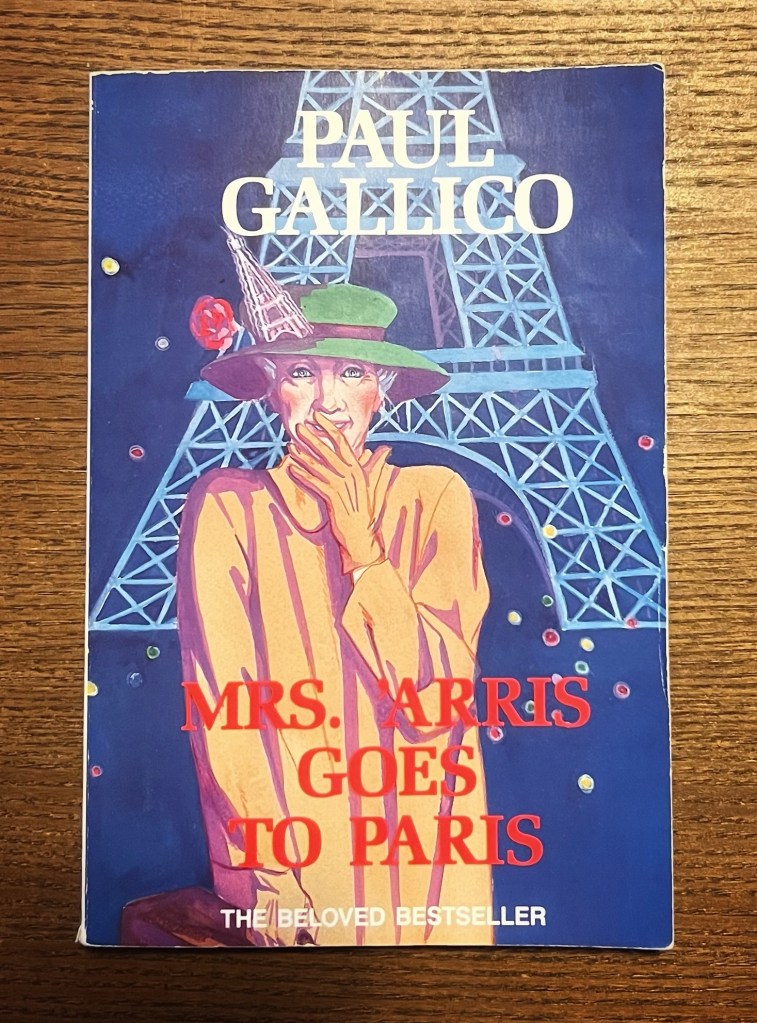
If a perfect French raspberry mousse could turn itself into a book, Mrs. ‘Arris Goes to Paris would be it. Light, rich, colourful, pleasing to the eye, but requiring a high level of skill to pull off. Written in 1957, it tells the story of Mrs. Harris, a clean lady (charwoman) in London in the mid-1950s that accidentally discovers a Dior dress while cleaning one of her client’s homes and decides upon the spot that she will own one herself.
Drab and colourless as her existence would seem to have been, Mrs. Harris had always felt a craving for beauty and colour and which up to this moment had manifested itself in a love for flowers. She had the proverbial green thumb, coupled with no little skill, and plants flourished for her where they would not, quite possibly, for any other.
Outside the windows of her basement flat were two window boxes of geraniums, her favorite flower, and inside, wherever there was room, there was a little pot containing a geranium struggling desperately to conquer its environment, or a single hyacinth or tulip, bought from a barrow for a heard-earned shilling.
Then, too, the people for whom she worked would sometimes present her with the leavings of their cut flowers which in their wilted state she would take home and try to nurse back to health, and once in a while, particularly in the spring, she would buy herself a little box of pansies, primroses or anemones. As long as she had flowers Mrs. Harris had no serious complaints concerning the life she led. They were her escape from the somber stone desert in which she lived. These bright flashes of colour satisfied her. They were something to return to in the evening, something to wake up to in the morning.
But now as she stood before the stunning creations hanging in the closet, she found herself face to face with a new kind of beauty – an artificial one created by the hand of man the artist, but aimed directly and cunningly at the heart of woman. In that very instant she fell victim to the artist; at that very moment there was born within her the craving to possess such a garment.
The first half of the book follows Mrs. Harris adventures in saving up the required 450 British Pounds (approximately $12,150 USD in today’s money). It takes her 2 years, 7 months, 3 weeks and 1 day. During that time she encounters many obstacles including an unfortunate flea, a fictional nephew in Chattanooga and a passport photographer with no appreciation for hats.
Thereafter, for the next hour and a half, before the enthralled eyes of Mrs. Harris, some ten models paraded one hundred and twenty specimens of the highest dressmaker’s art to be found in the most degenerately civilized city in the world.
The second half of the book follows Mrs. Harris turning Paris upside down. She meets a Marquis, matchmakes 2 young people in love, and helps the directrice of Dior find her kindness and save her marriage. Throughout, Mrs. Harris has some very funny observations.
Dear me, Mrs. Harris thought to herself as she and Natasha donned head cloths and aprons and seized upon brooms and dust cloths, French people are just like anyone else, plain and kind, only maybe a little dirtier. Now, ‘oh would have thought it after all one ‘ears?
Towards the end, as Mrs. Harris readies herself to bring her Dior dress back home, she learns of duty tax, which given the price of the dress, is not something she can afford. The entire Dior House is up in arms; the description of their approach to problem-solving rings true for anyone who has ever worked with the French.
The story of the dilemma ran like wildfire through the building. Experts appeared from all sides to give advice, including that there be a petition directed to the British Ambassador, until it was pointed out that so stern was the British regard for the law that not even the Ambassador or the Queen herself could intervene to have it set aside, even in so worthy a cause …
Of course the book ends with a happy ending, but not the one we were expecting or hoping for Mrs. Harris. The ending is what stops this story from being a simple puff pastry and elevates it to something that lingers and comforts long after the last page.
I do wonder what my mother was thinking of when she gifted me this book for my 13th birthday. Did she guess that I was going to fall in love with Paris, that when struggling with depression, Paris would be my go-to destination because it forced me to see beauty everywhere, including my own? Did she suspect that I would live a life sprinkled with loneliness, much like Mrs. Harris? Or that I would subscribe to the ideology that life is a grind, and that one’s merit is linked to how well one submits to that grind, without complaint? That I would buy into the notion that everyone has a « lane » they should stick to, and that stepping out of one’s lane is to invite ridicule and shame? Or maybe she was thinking of her own my mother, my Baba, similar to Mrs. Harris in so many ways, from her profession to her green thumb, looking for beauty after living through WWII.
I’ll never know what my mother was intending with this gift. What I do know is that this book is a cozy blanket of comfort, hope and grit, and it did me more good at 39 than it ever could have at 13. What a wise Mama!
A few words I discovered while reading this book:
- Charwoman: (n.) a cleaning lady.
- Catalepsy: (n.) trance or seizure; rigid body.
- Half betwixt & between: (adv.) in a midway position; neither one thing nor the other.
- Portent: (n.) a foreboding.
- Chinchilla: (n.) a (very cute) South American rodent with velvet-like fur.
- Niobe: (n.) Niobe, in Greek mythology, the daughter of Tantalus and the wife of King Amphion of Thebes. A beautiful and tragic figure, she is the prototype of the bereaved mother, weeping for the loss of her children.
- Slatternly: (adj.) dirty and untidy (typically used of a woman or her appearance). (This is the first definition that pops up on Google, attributed to Oxford dictionary. However, if you go to the online Oxford dictionary proper, no reference is made to women or their appearances. The internet sometimes…)
- Nutria: (n.) a semiaquatic large rodent, of the family of “spiny rats”, hunted for its water-resistant fur.
- Cowslip: (n.) cute yellow flower.
- Homburg: (n.) a hat that is a less-formal, daytime version of a top hat.


One response to “‘Mrs. ‘Arris Goes To Paris’: Grit in a Ballgown”
I read the book when I was studying english. But the title was Flowers for Mrs. Harris.
LikeLiked by 1 person