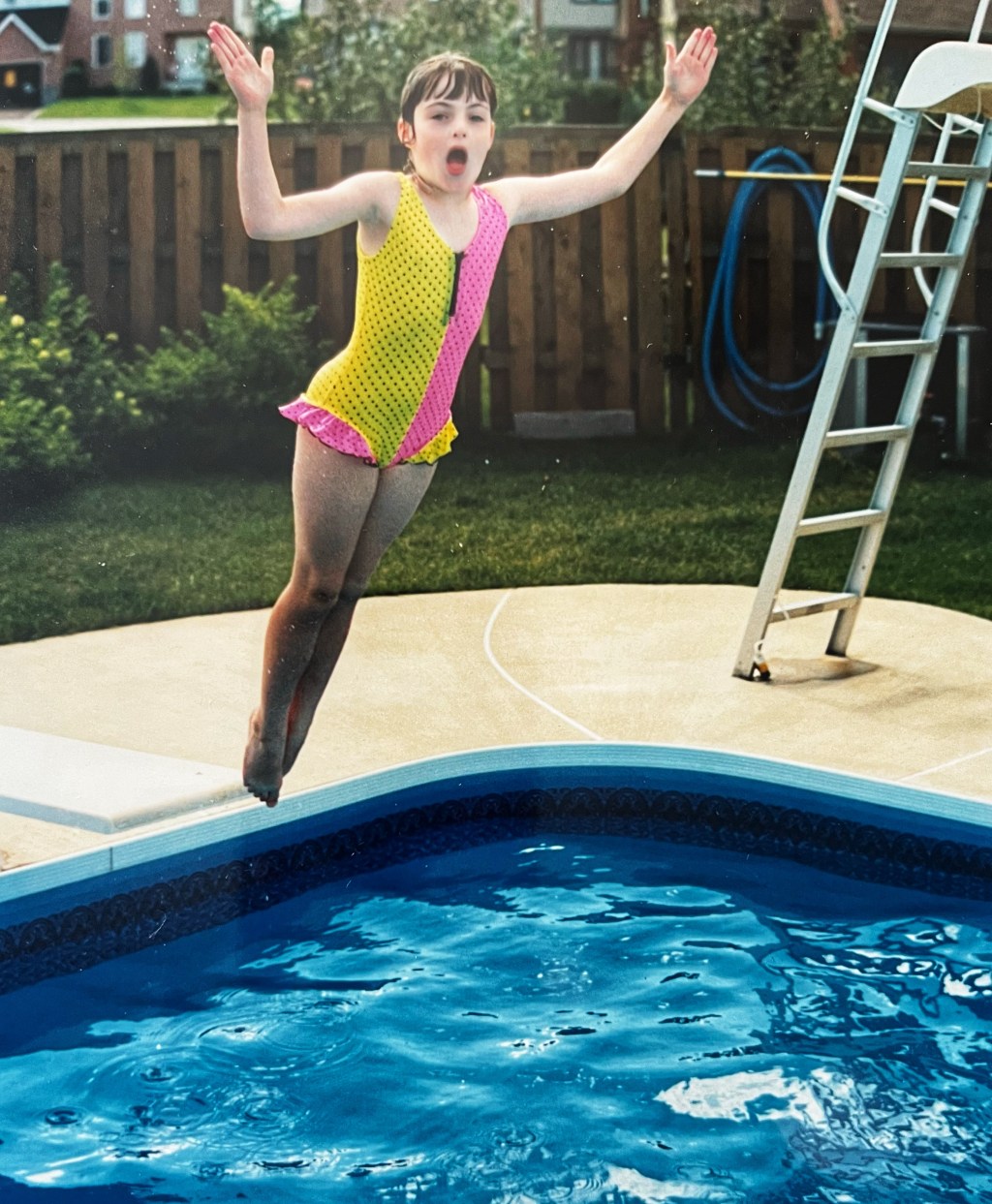
Diving Lessons, Mother’s Perspective
My mother would tell me the story of my diving lessons often.
Junie, sweetie, you would climb all the way up to the 5m diving board, stand there frozen, holding up the other children. The entire Pointe-Claire Swim Club staff, swimmers and parents would cheer you on from the ground, encouraging you to jump. And you would try!
We’d see you tense your little body, inching one toe off the ledge then another, take a deep breath… and then you’d step back. Over and over until the teacher made you climb down so that the other children could practice. And when I’d ask you after each lesson if you wanted to stop, you’d cry and beg me not to. I didn’t know what to do so I trusted you.
Yet you never jumped.
Diving Lessons, Interpreted by my Mother
She told me this story often in the years after I stopped diving lessons, when I was 10-12 years old, perhaps hoping that I’d explain my behaviour now that I was older and reassure her that she’d done the right thing as a parent.
She told me this story all through my teenage years, whenever we were arguing about some unfinished task, as a reminder of my character: an inability to follow through on my commitments.
She told me this story all through my early adult years, typically when I was struggling with a decision between security or one of calculated risk-taking. Stunned at my decision to go into accounting when every fibre in my body yearned to tell stories, my mother now viewed this as a cautionary tale of the price of fear.
Diving Lessons, My Perspective
I always wondered why she told me that story as if I hadn’t been there or didn’t remember. I did and I do.
I remember the smell of the chlorine, the shape of my bewildered diving instructor, the kind lifeguards. We didn’t know then that I was very nearsighted with limited depth perception – I couldn’t gage my distance to the water. I remember the cheers that were meant to encourage me but ringed out so loudly, they overwhelmed and paralyzed me instead – we didn’t have terms then like “sensory overload” or “spectrum”, and even if we did, 8 year-old me wouldn’t have known to use them.
I remember the nauseating climb down the wet, slippery spiral staircase. To this day, when faced with a spiral staircase – most often when visiting some European historical architectural delight – I freeze before turning into a tottering grandma, clutching at walls to prevent a dangerous topple forward. The climb down from the 5m platform was interminable, made more excruciating by the shame I felt at having failed again in front of all these people who continued to cheer me on. I wanted so badly to make them proud; I never did.
Diving Lessons, Re-Interpreted
My mother is no longer with us now, so I can’t tell her how I remember this story every time I’ve wanted to write, but silenced myself instead. Every time I shut down my laptop or crumpled a page of scribbled writing, I’ve felt myself climbing down those same scary stairs alongside my younger self, haunted by the cheers I couldn’t live up to. And like my baffled mother, I’d ask myself whether or not I should just give up. Over time, tired of searching for explanations for my writer’s block, I agreed with my mother’s assessment: I couldn’t help it, I just had no that follow through, dating all the way back to my childhood!
Recently, I’ve reconsidered what, exactly, this tale might be cautioning against. What if, despite the stream of failures, my weekly return to the diving board represented an awareness that on the other side of fear lay adventure and thrill? What if showing up despite an awareness of the pain of failure was an indication of grit to be fostered? Similarly, what if my unwillingness to abandon the idea of writing is not a childlike inability to know when to quit, but instead an ongoing invitation to launch myself off that high platform, despite my fears, and with no guarantee that I’ll land safely?
If only I could tell my mother now: at 40, I finally choose to jump. I find myself in free-fall and it’s exhilarating.


Leave a comment