My one true love
I remember the first time I fell in love with ballet.
I was 6 years old. Mme Mansour, our ballet teacher, had reached the breaking point with our class, a bunch of brats in pink leotards seemingly incapable of standing in a straight diagonal line. This was the first time I was witnessing an adult lose their temper about something that wasn’t related to our homework or how we children played together during recess. That seemed unusual, so I started paying attention.
I paid attention to Mme Mansour for 6 more years, until repeated knee injuries ended my active participation in ballet. During those years, I learned much from Mme Mansour. How ballet is a communion between music, choreography, dancers and audience – it serves to express emotions that cannot be distilled into language. As a pre-teen, I had many such emotions; I still do today. Mme Mansour also taught us the importance of always dancing as though it was a recital night. I was a bit of a ham, so that suited me just fine. Looking back, I see now that Mme Mansour was teaching us a valuable life lesson: with storytelling, you cannot dose truth for it is the authenticity of the emotion offered up that creates the purest of connections between performer and audience.
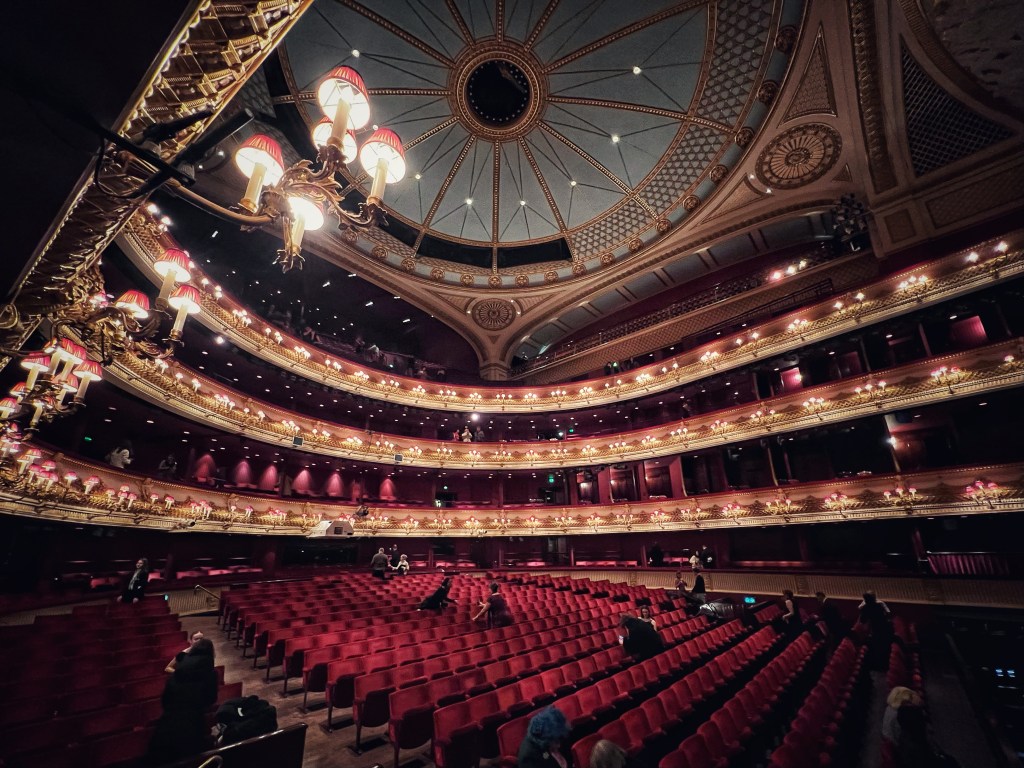
Royal Opera House in Covent Garden
Growing up, I didn’t know who Michael Jackson was. But I knew all about the Royal Opera House in Covent Garden. My mother had kept all the paper copies of an arts and culture magazine from the 1950s through 1970s. LIFE maybe? I would hide out in the basement and read every article about ballet, learning about les Ballets Russes, Diaghilev, Pavlova, Nijinsky, Nureyev and his game-changing partnership with Fonteyn, Baryshnikov, as well as other dance legends like Fred Astaire and Gene Kelly. I didn’t realize I was giving myself an education in dance history: I’d read 3 decades’ worth of reviews and critiques about Opera and Ballet, all before turning 15.
Covent Garden was the birthplace of many of the ballets we now take for granted. Romeo & Juliet, La fille mal gardée, Manon, all found success at the Royal Opera House in the 1960s and 1970s before making their way across the globe. Since these ballets were created on ROH dancers, once retired, these dancers would turn répétiteurs, and train in turn the generations of younger dancers. At Covent Garden, history isn’t a static or abstract moment in time; history is accessible, clearly tied to present day traditions. For example, Nureyev was a master at milking curtain calls – his record was 89 – some of his practices continue at the ROH to his day!
It was 1965 when Margot Fonteyn and Rudolf Nureyev danced the title roles in the premiere of Kenneth Macmillan’s Romeo and Juliet in Covent Garden. The perfect culmination of two superstars, Prokofiev’s magnificent score, and Macmillan’s (now) iconic production resulted in Fonteyn and Nureyev reportedly taking 40 curtain calls that evening. One can imagine the audience erupting that evening, on their feet enraptured at what they had witnessed. One rumbling body of respect and admiration. Curtain calls like this are now somewhat of a rarity, but we all dance on, in hope that one day, we will be as Fonteyn and Nureyev were, and the lucky few since them – greeted by rapturous applause. Even if we never quite reach that level, as dancers, being applauded for our art is one of the greatest indulgences an artist can ever be afforded. And that is why the ritual persists.
The Ritual of the Curtain Call, Annie Carroll
Swan Lake: a tale of broken promises
Ask a stranger on the street to name a ballet and chances are he/she will say either Swan Lake or the Nutcracker. Swan Lake is the image in every little girl’s mind when she says she wants to be a ballerina one day; stiff white tutu and arabesque. It is also one of the most technically & artistically demanding roles for the ballerina playing Odette/Odile.
Swan Lake tells the story of a princess Odette who, cursed by the evil magician Rothbart, is condemned to live her days as a swan, changing back to human form at night. Only an unbroken promise of true love can set her free. She meets Prince Siegfried one night as he wanders the forest ruminating on his parents’ insistence he marry and ensure the succession line. They dance in the moonlight and fall in love. The following day, his parents host a ball and order Siegfried to choose a bride from amongst the guests. Siegfried despairs because he loves Odette. To his delight, Odette appears accompanied by a mysterious chevalier gallant. What Siegfried does not know is that this chevalier gallant is none other than the magician Rothbart who has cursed his beloved Odette! The beautiful maiden that accompanies him is not Odette but Rothbart’s own daughter Odile who he has charmed to appear to Siegfried in Odette’s form. Odile seduces Siegfried, who declares publicly his intention to marry her. Rothbart reveals himself, and Siegfried realizes he has just betrayed Odette. He runs to the forest to find her dying.
An unusual ending
Unlike operas or symphonies, where there is only one version of each piece, and the only difference between seeing it in the 1970s in New York vs 2020s in Paris is the unique interpretation of the artists portraying the characters and playing the instruments, classical ballets frequently have multiple versions to the same musical score, each signed by a different choreographer. In the case of Swan Lake, the original version was choreographed by Marius Pepita and Lev Ivanov in 1895. Since then, the following many big names in ballet have put their stamp on it: Rudolf Nureyev, George Balanchine, Sir Frederick Ashton, John Neumeier, Yuri Grigorovich. Typically, most endings fall into one of two categories, with minor variations:
- Siegfried’s betrayal of Odile condemns her evermore to the swan form, she commits suicide, and Siegfried either dies fighting Rothbart or jumps into the lake in despair; or
- Siegfried and Odile’s love is so pure, his remorse so deep, that her curse is lifted, Rothbart’s powers are eliminated, and they live happily ever after.
For the most part, the endings present Siegfried and Odile as united, either in life or in death – a testament to the depth of their love. The Royal Opera House’s version by Liam Scarlett (*) is different: Odile throws herself in the lake, Siegfried wrestles with Rothbart whose powers wane in the face of Siegfried’s enduring love for Odile, Siegfried rushes to the lake to rescue Odile, only to find her lifeless human body. The curse has been lifted, too late.
A great performance
I’ve always found that the best ballet dancers are still. Not physically, of course. They are so fully present that the air hangs on their limbs, and their movements fill the music rather than follow the music. There is no interference between their physicality and the emotions they have been entrusted to convey without artifice or ego. As an audience member, while we are enjoying a visual spectacle given by highly trained athletes, we are actually responding to the vulnerability and skilled storytelling of the dancers: they bare their souls on stage, and when it works, dancers and audiences witness the birth of a precious moment of truth.
Friday’s performance at the ROH was just such a night. Fumi Kaneko, as Odette, took us on sweeping journey: grief-stricken, slow to trust, cautiously in love, filled with hope, and then heart-broken as she faced her inevitable fate. As Odile, she was a cunning seductress, careful to reveal her true side to the audience every time Siegfried’s back was turned; to him, she mimicked Odette’s softer and shyer moves. No one in the audience blamed Siegfried for being dazzled and tricked: he never stood a chance. Meanwhile, Siegfried (danced by William Bracewell) charmed us as a prince who fully accepted the weight of his princely duties, and wished to carry those responsibilities accompanied by a woman he esteemed and loved. His horror upon realizing he had unwittingly betrayed Odette was poignant. Their last dance together had us all weeping: it was the physical embodiment of the realization that some mistakes can never be repaired, regardless of forgiveness, regret and love.
That is why, to me at least, Liam Scarlett’s adaptation of Swan Lake is the best there is. It eschews the pat either/or of other variations. Either Odette & Siegfried both live, or they both die. That doesn’t ring true. How many of us have experienced the rug being pulled out from under us, a mistake (or worse, a choice) made, and we know with absolute certainty that there can be no going back? Scarlett’s ballet encourages us to accept these moments for what they are: a permanent separation of ways. Scarlett’s own life and death is reflective of this.
As someone who has both been the betrayer and the betrayed, I was gutted by this performance – a sign of successful storytelling, if ever there was one! But more than that, I was comforted. I suspect we all go through life believing our tragedies to be individual and unknowable. However, the power of this ballet is that Odette/Siegfried’s story is universal: we are not alone, their pain and regret are as true as our own, and in living that truth with them, our individual tragedies become shared. As we marvel at the beautiful heartbreak of their story, it becomes easier to see the beauty in our own stories. What a miracle.
Ballet: my one true love.
(*) Interested in learning more about Liam Scarlett and the nuances surrounding his work and his death? No better source than one of the greatest living dance critics and historians of the performing arts, Alastair Macaulay. Check it out here.
Interested in the ROH but hopping on a plane to go halfway around the world currently isn’t feasible? No worries! They offer a fantastic and affordable streaming service. I have gifted it as a Xmas present more than once. Check it out here.


Leave a comment