
The Diary of a Nobody is one of the first books that caught my eye as I was sorting through my mother’s collection. She had two copies – not in itself an indication of a favorite. My mother would buy updated versions of the same book over the years either because she enjoyed the introductions or the feel of the paper. Usually she would store them to give as gifts to unidentified recipients for an unidentified future date. Sometimes she would give them out, sometimes she’d change her mind as to the recipient’s likely appreciation, sometimes she would keep them for herself. I noticed that for most of the books she gave me in the last 10 years of her life, she had gotten herself the same version. Twins! Also, as her status of Person Who Reads All The Books grew amongst friends and family, what better gift to give her than a beautiful edition of a classic? That can be the only explanation for her owning 5 versions of the Dickens entire collection of published works. No one loves Dickens that much, and from memory my mother found Dickens unnecessarily wordy. But my mother did love receiving gifts for the memories it gave her, and so she would have accepted every duplicate book with a delighted smile and kept the secret of the duplication to herself.
Having now read the Diary of a Nobody, I suspect that this is a book that my mother purchased twice, once for herself and once with the intention of giving it as a gift – which never materialized. I think I know why. Mr Pooter is the Nobody to whom this fictional diary belongs. Set in the 1890s, in middle-class London, Mr Pooter is the original suburban dad. He takes great pride in the shabby-genteel home he shares with his loving wife Carrie, enjoys staying in, constantly worries about his boss and frets about the rowdiness of his adult son. He is secretly very pleased with his ability to crack a joke.
May 25 –
Carried brought down some of my shirts and advised me to take them to Trillip’s round the corner. She said: “The fronts and cuffs are much frayed.” I said without a moment’s hesitation: “I’m frayed they are.” Lor! how we roared. I thought we should never stop laughing. As I happened to be sitting next the driver going to town on the ‘bus, I told him my joke about the “frayed” shirts. I thought he would have rolled off his seat. They laughed at the office a good bit too over it.
May 26 –
Left the shirts to be repaired at Trillip’s I said to him: “I”m ‘fraid they are frayed.” He said, without a smile: “They’re bound to do that, sir.” Some people seem to be quite destitute of a sense of humor.
Mr Pooter begins and ends his diary as a man whose narrow world occupies his every waking moment. What keeps Mr Pooter’s diary from being tedious is his talent for finding himself in a steady stream of minor social humiliations and mishaps. My favorite one is where Mr Pooter visits a former schoolfellow for the first time in many years. The host offers Mr Pooter a tour of the house, and as is proper, Mr Pooter compliments his host by commenting favorably on the many family portraits hung on the walls. Unfortunately, Mr Pooter discovers with each successive compliment that the family members in question have recently passed away; by the end of the house tour, his host is rather glum.
The heart of the book is discovered towards the end, when Mr Pooter and his wife are invited to a fancy dinner and are introduced to Mr Huttle, a big shot American businessman.
I shall never forget the effect the words, ‘happy medium’ had upon him. He was brilliant and most daring in his interpretation of the words. He positively alarmed me. He said something like the following: ‘Happy medium, indeed. Do you know “happy medium” are two words which mean “miserable mediocrity”? I say, go first class or go third; marry a duchess or her kitchen-maid. The happy medium means respectability, and respectability means insipidness. Does it not, Mr Pooter?’
I was so taken aback by being personally appealed to, that I could only bow apologetically, and say that I feared I was not competent to offer an opinion.
(…)
He continued, with an amazing eloquence that made his unwelcome opinions positively convincing: ‘The happy medium is nothing more or less than a vulgar half-measure. A man who loves champagne and, finding a pint too little, fears to face a whole bottle and has recourse to an imperial pint, will never build a Brooklyn Bridge or an Eiffel Tower. No, he is half-hearted, he is a half-measure – respectable – in fact, a happy medium, and will spend the rest of his days in a suburban villa with a stucco-column portico, resembling a four-post bedstead.
On their ride home after the dinner, Carrie shares her worry that Mr. Huttle reminds her of Lupin, their son.
The comparison kept me awake half the night. Mr Huttle was, of course, an older and more influential man; but he was like Lupin, and it made me think how dangerous Lupin would be if he were older and more influential. I feel proud that Lupin does resemble Mr Huttle in some ways. Lupin, like Mr Huttle, has original and sometimes wonderful ideas; but it is those ideas that are so dangerous. They make men extremely rich or extremely poor. They make or break men. I always feel people are happier who live a simple and unsophisticated life. I believe I am happy because I am not ambitious.
And that is what elevates the Diary above a mildly amusing spoof of middle-class suburbia. Even as it pokes fun and gently ridicules all the Mr Pooters of this world (and having grown up in the suburbs, I recognized many Mr and Mrs Pooters in my life!) it also invites us to appreciate and admire all his good qualities that are worthy of respect – that are respectable – his devotion to his wife, his loyalty to his friends, his work ethic and the pride he takes in his son. Mr Pooter is ridiculous and respectable: 130 years after its publication Mr Pooter’s diary remains current and relatable.
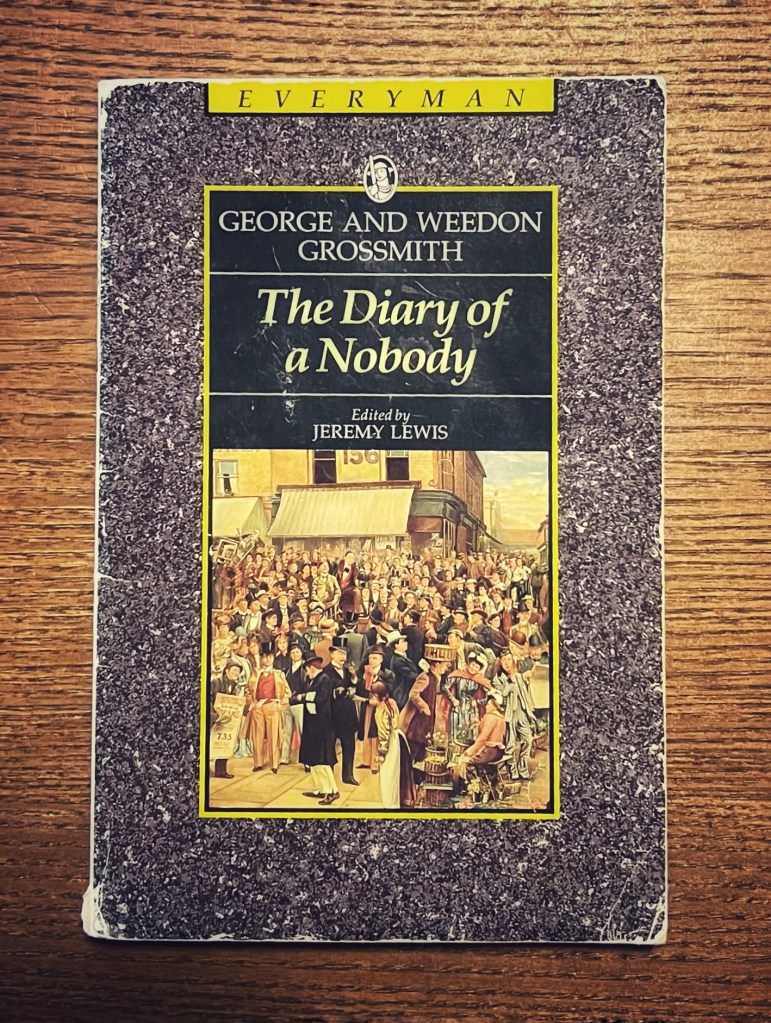
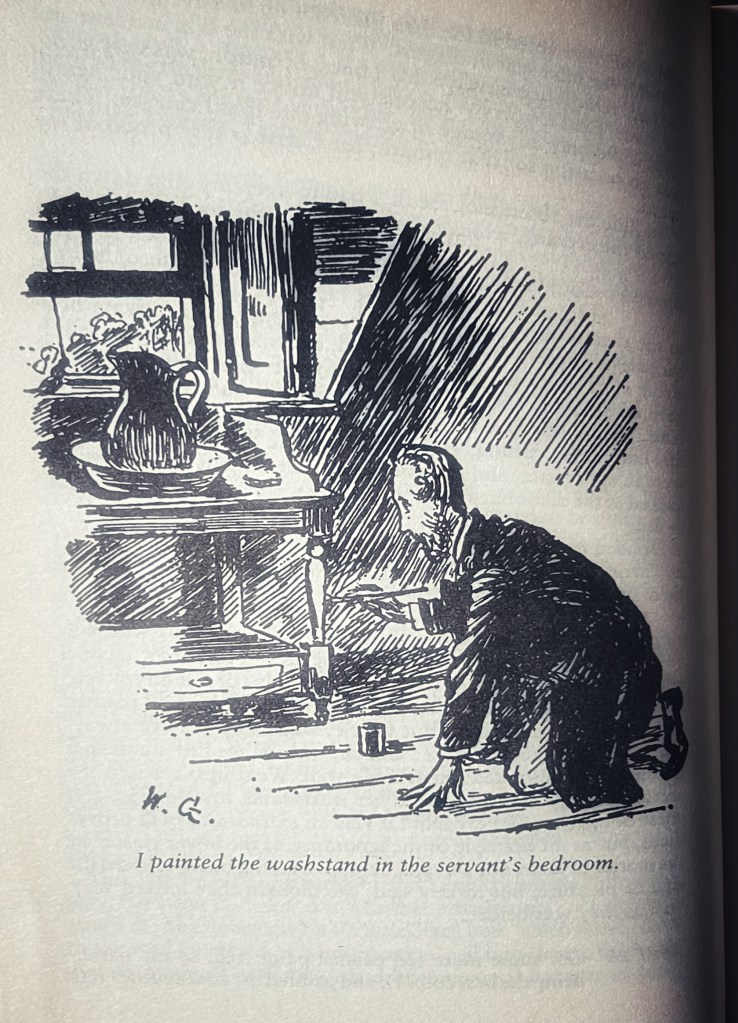
The Diary of Nobody was first published in 1892, written by the Grossmith brothers, George and Weedon. George is thought to have done most of the writing while Weedon drew the illustrations. The drawings are fantastic, really driving home the humour described in the diary entries. Take the incident of Mr Pooter and the red enamel paint. Following the recommendation of his work supervisor as to the merits of Pinkford’s enamel paint, Mr Pooter immediately hastens to buy two tins of bright red paint on his way home from work. Why red? Because it is the best colour, to Mr Pooter’s mind. In the next 48h, Mr Pooter paints in bright red the flower pots, the maid’s washstand, towel-horse and chest of drawers (Sarah the maid was not impressed), the coal-scuttle and the backs of his and Carrie’s Shakespeare, “the binding of which had almost worn out”.
April 27 –
Painted the bath red, and was delighted with the result. Sorry to say Carrie was not, in fact we had a few words about it. She said I ought to have consulted her, and she had never heard of a thing as a bath being painted red. I replied: “It’s merely a matter of taste.”
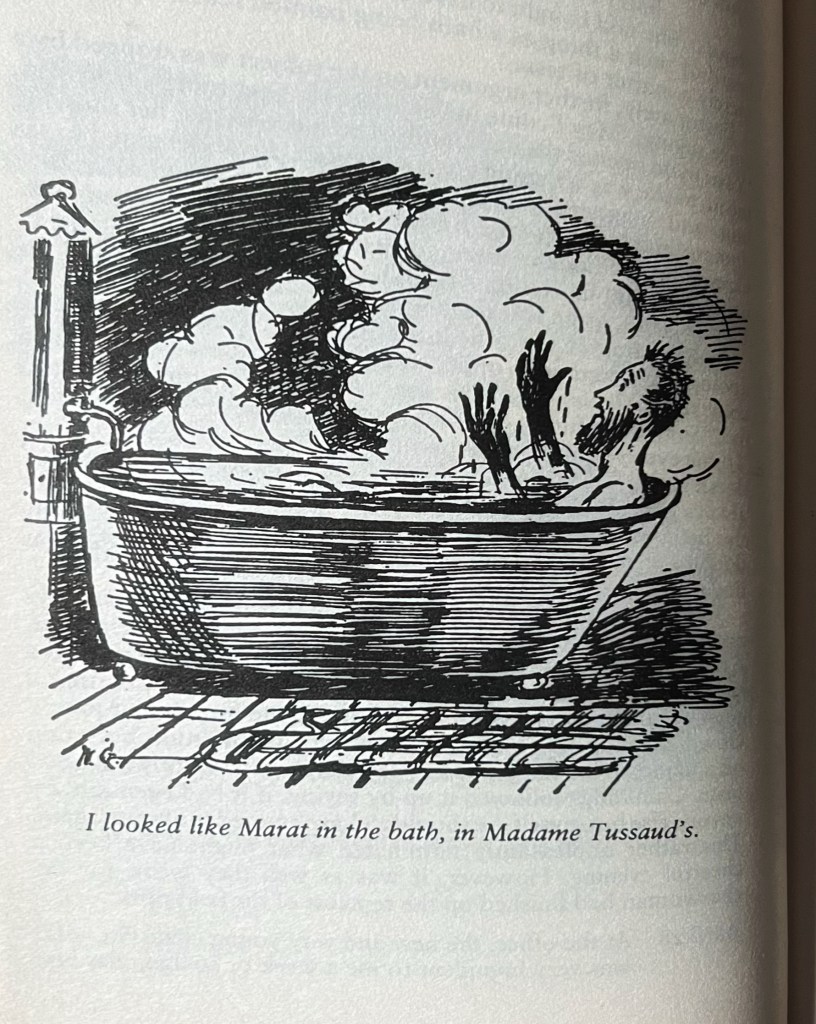
Two days later, suffering from a head cold, Mr Pooter draws himself a very hot bath.
On moving my hand above the surface of the water, I experienced the greatest fright I ever received in the whole course of my life; for imagine my horror on discovering my hand, as I thought, full of blood. My first thought was that I had ruptured and artery, and was bleeding to death, and should be discovered, later on, looking like a second Marat, as I remember seeing him in Madame Tussaud’s. My second thought was to ring the bell, but remembered there was no bell to ring. My third was, that there was nothing but the enamel paint, which had dissolved with boiling water. I stepped out of the bath, perfectly red all over, resembling the Red Indians I have seen depicted at an East-End theatre. I determined not to say a word to Carrie, but to tell Farmerson to come on Monday and paint the bath white.
Beware to anyone looking to gift the Diary of A Nobody to a friend or acquaintance. It can be tricky. I excitedly regifted my mother’s second copy of the book to the husband of one of my dear friends, “I just know you’ll enjoy this book, I immediately thought of you!”. He took one look at the title and dryly thanked me for keeping him humble. Oops.
A few words I discovered while reading this book:
- Antimacassar: (n.) a piece of cloth put over the back of a chair to protect it from grease and dirt or as an ornament.
- Blacmange: (n.) a sweet dessert popular throughout Europe commonly made with milk or cream and sugar thickened with rice flour, gelatin, corn starch, or Irish moss, and often flavoured with almonds. It is usually set in a mould and served cold.
- Cornice: (n.) an ornamental molding around the wall of a room just below the ceiling.
- To countermand: (v.) to revoke a previously issued order.
- Extemporised: (adj.) improvised.
- Foolscap: (n.) traditional paper size used in Great Britain and throughout the British Commonwealth prior to the adoption of the international standard A4 paper size.
- Squib: (n.) a small firework that burns with a hissing sound before exploding; a short piece of satirical writing. (Again, only knew this word from Harry Potter for non-magical children born of wizarding parents! I’m discovering additional layers of wit to J.K. Rowling’s writing!)


Leave a comment